


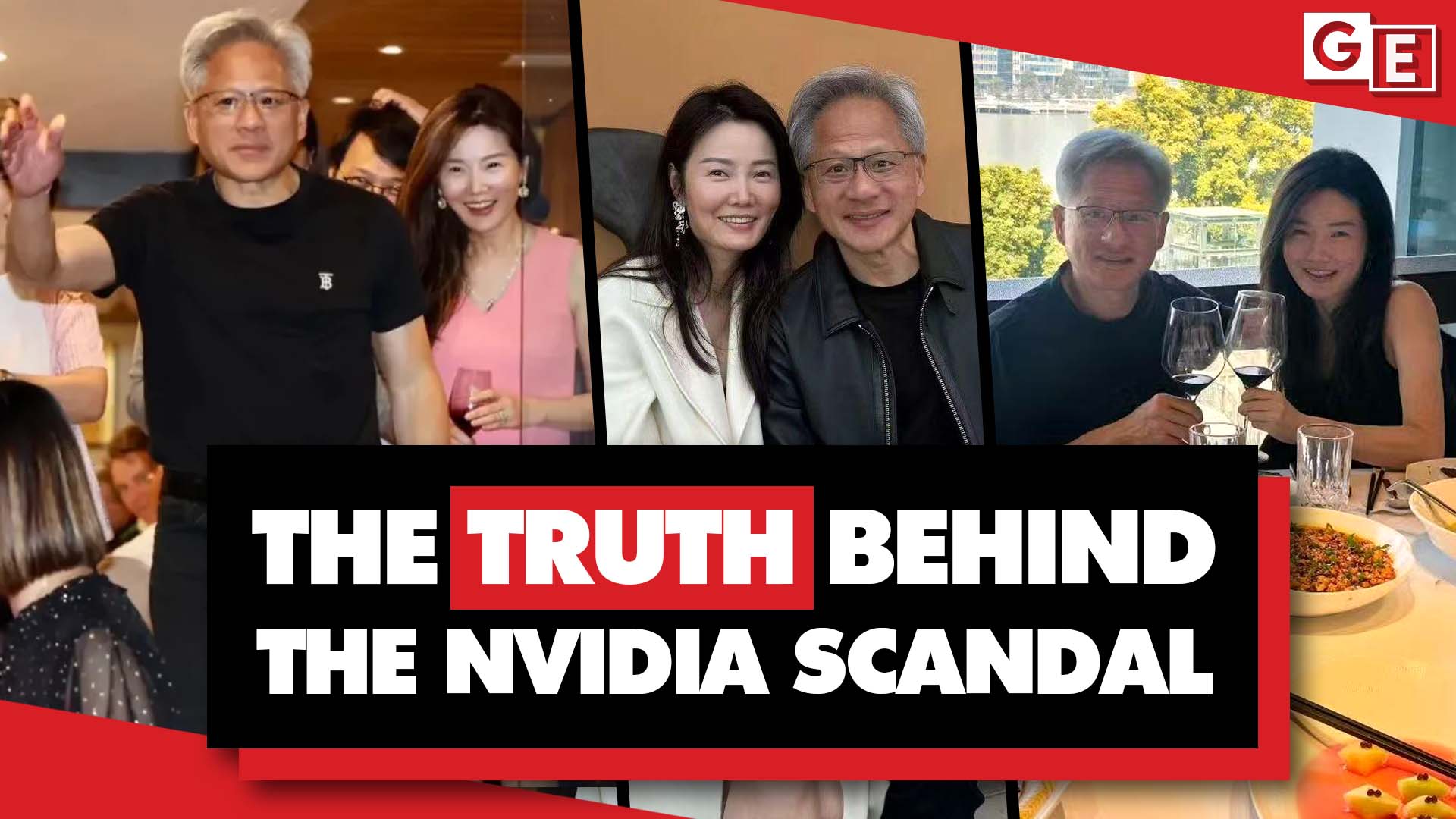
US intelligence agencies claim CEO Jensen Huang of Nvidia, one of the most powerful companies on Earth, had an affair with a Chinese spy. However, there is no proof of this.
In fact, all of the evidence suggests something much less nefarious: that Jensen Huang’s lover Alice Huang (of no relation) is simply a Chinese businesswoman who was helping Nvidia bypass US export restrictions in order to sell AI chips to Chinese companies — against the wishes of both the US and Chinese governments.
No evidence that Alice Huang is a Chinese spy
Analyst Arnaud Bertrand dug through the details of many of the Western media reports alleging that Alice Huang is a Chinese spy. He noted that no evidence of this has been presented.
The accusations originated entirely with anonymous US intelligence officials.
In fact, Bertrand pointed out that the Wall Street Journal had a major error in its reporting. The newspaper claimed that the Singaporean government had accused Alice Huang of being a Chinese intelligence source.
But Singapore’s Ministry of Home Affairs published a statement emphasizing: “neither the Singapore Government nor its officials said this. And there were no such investigations conducted in respect of Alice Huang”.
For her part, Alice Huang did nothing to hide her relationship with Jensen Huang. She appeared with him in public multiple times.

On her WeChat account, Alice Huang even posted intimate photos of the two eating dinner, drinking wine, and taking walks. If she were a spy, she would have likely tried to hide her relationship with Jensen Huang, not boasted about it as she did.

China experts say Alice Huang was likely a smuggler, not a spy
Inside China, many people are deeply skeptical of these US allegations.
Shaun Rein is an American businessman who has lived in China for many years and knows the business environment well. In a long post on Twitter, he explained that it is highly unlikely that Alice Huang is a Chinese spy.
Instead, he argued that Alice Huang is likely a smuggler. She is almost certainly one of the many “people who would buy Nvidia chips to rent to Alibaba or to smuggle into the mainland against the wishes of both the Chinese and American governments”.
Rein noted that these kinds of smuggling operations are rather common in China. In the past, these shady businesspeople were known for smuggling iPhones, baby formula, and luxury handbags. AI chips are only the latest fad.
Chip war: Inside the US tech war against China
The reason this scandal has been so heavily politicized is because it is part of the larger “chip war” that the United States has been waging against China.
In 2022, the Joe Biden administration banned the export of GPUs to China. This was the opening shot of the AI arms race.
The US commerce secretary under Biden, the wealthy venture capitalist and China hawk Gina Raimondo, admitted that Washington’s goal was “to slow down China’s rate of innovation”.
Hawks in Washington and some US Big Tech companies (especially OpenAI and Anthropic) have sought to prevent China from getting access to advanced chips needed to train AI models, in an attempt to monopolize the technology and sabotage their Chinese competitors.
Anthropic CEO Dario Amodei publicly lobbied the US government to impose even harsher chip export restrictions on China. He wrote that the US must have a monopoly over this crucial technology, in order to maintain a “unipolar world” (in his words).
However, China is a massive country with many tech companies that want access to cutting-edge AI chips.
So an underground industry emerged in which businesspeople made lots of money smuggling Nvidia chips into China.
This was not a secret. The Wall Street Journal wrote a big article about it in 2024.
In 2025, Bloomberg published a report about a Singapore-based company called Megaspeed, which it said was helping Chinese companies get Nvidia chips, thereby circumventing US export restrictions.
Alice Huang ran Megaspeed, which built large data centers in Southeast Asia. The Financial Times reported that Alice Huang had boasted to potential Chinese investors that it could get them access to Nvidia chips, naming the Chinese tech giant Alibaba as an example.
Nvidia wanted access to the Chinese market
China hawks are using the US intelligence officials’ accusations against Jensen Huang to craft an elaborate conspiracy, claiming that the Nvidia CEO was violating US export restrictions and selling AI chips to Chinese companies because he was compromised by a Chinese spy.
This is absurd. There is no evidence of this.
In reality, there is a very easy explanation for why Jensen Huang was doing this: Nvidia made a lot of money.
In 2025, Jensen Huang noted that, before the US government had imposed export restrictions on China, Nvidia had 95% of the market share for advanced chips in China. However, he complained that that figure had fallen to 0% (or so he said).
Clearly, Nvidia has a massive economic interest in avoiding these export restrictions, to keep selling to Chinese firms, albeit indirectly.
Jensen Huang did not need to be blackmailed by a supposed Chinese spy to do this. The billionaire was simply following his own economic incentives.
The Chinese government restricted Nvidia, instead promoting the domestic chip industry
Another reason why it is unlikely that Alice Huang is a Chinese spy is because Beijing has taken action to prevent Chinese tech companies from importing Nvidia chips.
The Chinese government has spent many billions of dollars in industrial policy measures to promote the development of the domestic chip industry.
Chinese officials want the country to reduce its dependency on the US tech stack, to become technologically self-sufficient.
This is why Beijing has ordered big companies like Alibaba to buy chips from Chinese firms, not Nvidia.
In fact, the Chinese government even took action to restrict Nvidia, arguing that the monopolistic US corporation violated its antitrust law.
In other words, Alice Huang was undermining the Chinese government’s intense efforts to develop the domestic chip industry.
Instead of serving Beijing’s interests, she was directly going against them. So why would the Chinese government recruit her as a spy?
What this scandal demonstrates is a conflict between the interests of the Chinese government and the interests of Chinese big tech companies.
For-profit corporations like Alibaba do not prioritize China’s development of an independent, self-sufficient, domestic chip industry.
Alibaba simply wants the best chips available, so it can develop its own AI models and make money. And Nvidia happens to make the best chips.
Alice Huang was working on behalf of these Chinese tech companies, not the Chinese government.

Why Trump allowed Nvidia to export chips to China
Although Donald Trump started the US trade war against China during his first term as president, he has also made some exceptions, when it serves the interests of US corporations.
Jensen Huang and Trump are close, and the Nvidia CEO clearly lobbied the US president to overturn some of the Biden administration’s export restrictions on China.
Jensen Huang succeeded, and, in 2025, the Trump administration reversed some of Biden’s measures, allowing Nvidia to sell some AI chips, such as the H200, to Chinese companies.
The argument made by Trump administration officials and Jensen Huang alike is that, by keeping Chinese firms dependent on Nvidia chips and the US tech stack, they could prevent China from developing alternatives to US technological monopolies, maintaining Silicon Valley’s “moat”.
US Commerce Secretary Howard Lutnick explained on CNBC: “You want to sell the Chinese enough that their developers get addicted to the American technology stack, that’s the thinking”.
Chinese policymakers could see this. This is precisely why Beijing responded to Trump’s policy by pressuring Chinese companies to reject Nvidia GPUs and to instead buy chips from domestic firms like Huawei.
But Trump and Jensen Huang repeatedly lobbied the Chinese government to drop its opposition.
When Trump visited Beijing this May, he was joined on Air Force One by Jensen Huang (and Elon Musk). When the US president met with President Xi Jinping and other Chinese officials, Huang was there (along with the executives of several other major US corporations).
(Although Elon Musk is very right-wing and echoes most conservative talking points, he has avoided attacking China because his companies are very dependent on the country. A slight majority (54%) of Tesla cars are produced in a “gigafactory” in Shanghai.)

Likewise, when President Xi visited Washington this September, Trump hosted a lavish dinner at the White House, featuring a Who’s Who of US corporate executives. Sitting at the table with Trump and Xi was Jensen Huang (as well as Elon Musk and Tim Cook).
Trump did all of this not because he is sympathetic to China, but merely because it benefited some huge US corporations, whose interests the billionaire US president serves above all.
However, China hawks in Washington have pointed to this to attack Trump from the right, portraying him as too soft on China.
China hawks and US Big Tech corporations are exploiting the Jensen Huang scandal
Some powerful forces in Washington and Silicon Valley have exploited the scandal surrounding Jensen Huang’s affair in order to push for more aggressive policies against China.
Anti-China media outlets have seized the moment to issue calls for a “tougher US line on China”.
Inside the Trump administration, neoconservatives like Marco Rubio have long advocated for punitive action against Huang, the New York Times reported.
Rubio is a lifelong neocon and extreme China hawk. He slightly toned down his warmongering rhetoric in order to work in the Trump administration, but several reports have revealed that Rubio is considering abandoning Trump, after the Republicans suffered an enormous defeat in the midterm election this November.
Rubio is a major presidential contender for the Republican Party in the 2028 election, and he will almost certainly demonize China as part of his campaign.
Likewise, the neoconservative leadership of the Democratic Party has attacked Trump from the right on China.
This September, right-wing Democratic Senator Chuck Schumer issued an extremely aggressive speech attacking China and demanding that Trump impose heavier restrictions on the country.
Then, this November, Schumer jumped on the Jensen Huang scandal to accuse Trump of undermining US so-called “national security”.
It is clear that neoconservative China hawks from both the Republican and Democratic Parties are manipulating the Jensen Huang scandal to promote an extremely hard line against Beijing.
They also have the support of some powerful billionaire oligarchs in Silicon Valley.
OpenAI’s billionaire CEO Sam Altman has publicly lobbied the US government to ban Chinese AI models. What is his argument to prohibit his main competition? They constitute a supposed “national security” threat.
Jensen Huang has been an outspoken advocate for open-source models, like those developed by Chinese AI companies. Aspiring US monopolies such as OpenAI and Anthropic fear these as an existential threat to their business model, so they would be happy to see Huang replaced by a more reliably anti-China CEO at Nvidia.


