


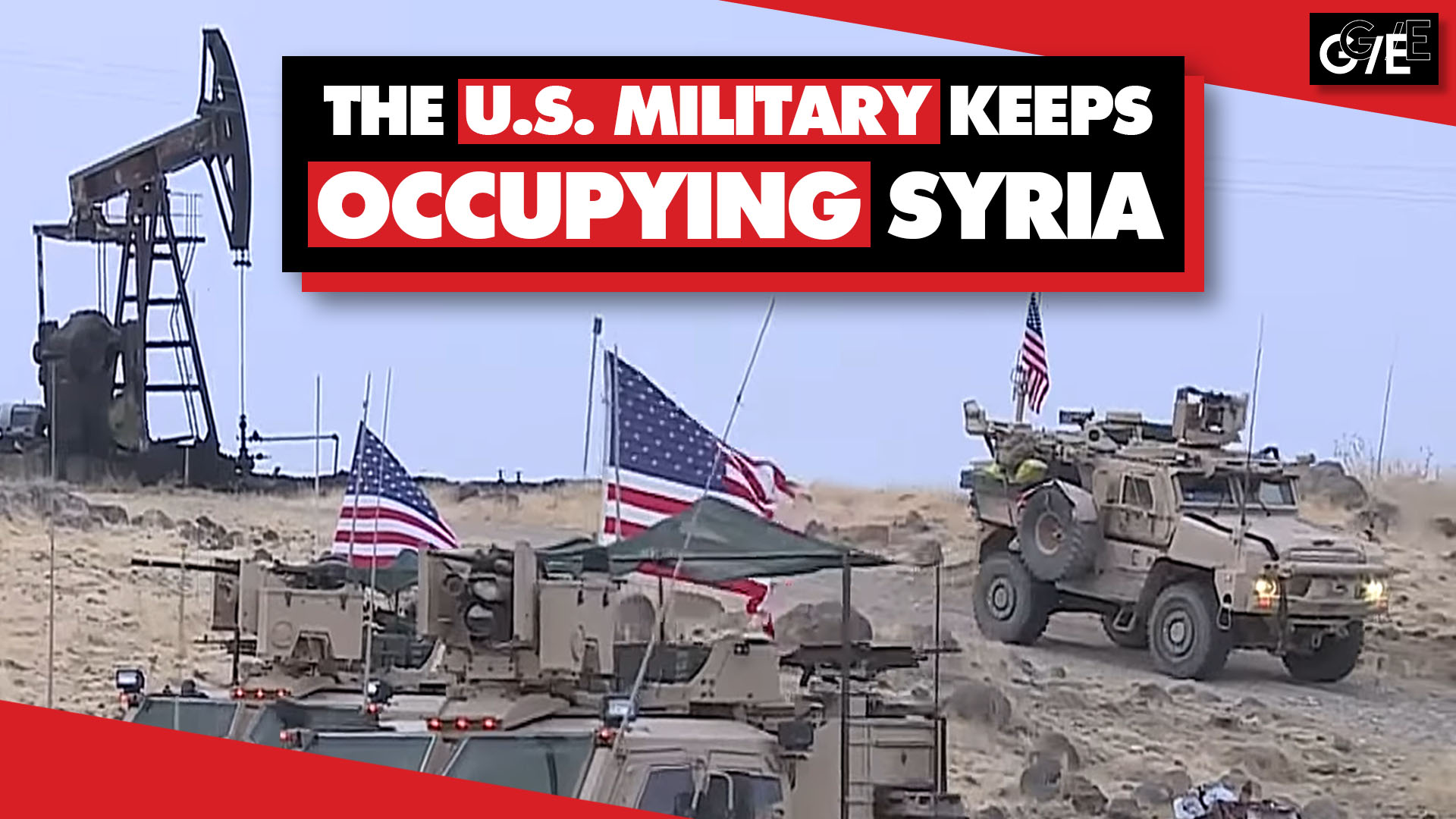
The US military has occupied Syrian sovereign territory since 2014, preventing Damascus from accessing its own oil and wheat fields.
A top Pentagon official has acknowledged that Washington’s strategy is to starve Syria’s central government of revenue it needs to rebuild, after a decade of war fueled by foreign powers devastated the country.
Former US President Donald Trump boasted in 2020: “They say, ‘He left troops in Syria’. You know what I did? I left troops to take the oil. I took the oil. The only troops I have are taking the oil. They’re protecting the oil. I took over the oil”.
The United States has at least 900 troops in Syria. Syria’s internationally recognized government has repeatedly called for them to leave, meaning the US military presence is illegal according to international law.
US Senate votes 13-84 against withdrawing troops from Syria
This issue has come up in Congress several times in recent years.
On December 7, the Senate voted 13-84, rejecting a resolution to withdraw the US troops.
The joint resolution, S.J.Res.51, “direct[ed] the removal of United States Armed Forces from hostilities in Syria that have not been authorized by Congress”.
Of the 100 members of the Senate, which is roughly evenly split between both parties, seven Democrats voted for the resolution, along with one left-wing independent who caucuses with the Democrats (Bernie Sanders) and five Republicans.
The senators who voted to withdraw US troops from Syria were the following:
Democrats (7)
- Dick Durbin (Illinois)
- Ed Markey (Massachusetts)
- Jeff Merkley (Oregon)
- Chris Murphy (Connecticut)
- Elizabeth Warren (Massachusetts)
- Peter Welch (Vermont)
- Ron Wyden (Oregon)
Independent (1)
- Bernie Sanders (Vermont)
Republicans (5)
- Mike Braun (Indiana)
- Mike Lee (Utah)
- Rand Paul (Kentucky)
- Tommy Tuberville (Alabama)
- JD Vance (Ohio)

The US Senate vote on whether or not to withdraw troops from Syria, on December 7, 2023
The resolution had been introduced by Rand Paul, a libertarian-leaning Republican senator from Kentucky.
The proposed legislation noted that US military forces have been active in Syria since September 22, 2014.
Since 2016, the resolution disclosed, US troops in Syria have attacked the Syrian government and its allies, including Iranian and Russian fighters, at least 11 times.
Both the Donald Trump and Joe Biden administrations repeatedly launched airstrikes in Syria against government and allied forces.
US occupies Syria’s oil fields
In March 2023, a senior United Nations official, Farhan Haq, inspired controversy when he falsely claimed “there’s no US armed forces inside of Syria”. (Chinese reporter Edward Xu corrected Haq’s lie, while calling out the UN’s hypocrisy on Ukraine.)
UN lies about US military occupation of Syria, reporter calls out Ukraine hypocrisy
The US corporate media was once quite open about this fact.
Back in 2018, neoconservative Washington Post columnist Josh Rogin bragged, “In Syria, we ‘took the oil’”. He emphasized that “the United States and its partners control almost all of the oil” in the country.
Then President Trump had claimed at the time that he wanted to withdraw US troops from Syria, but Rogin complained that, “if the United States leaves, that oil will likely fall into the hands of Iran”.
Trump listened to hawkish critics like Rogin and decided to backtrack, instead leaving the US troops – who remain there today.
NPR stated clearly in 2020, “U.S. forces in northeastern Syria have a relatively new mission: securing oil fields not only from ISIS, but also from Syrian government and Russian forces”.
Trump sat down for an interview with Fox News host Laura Ingraham that same year. The US president explained:
TRUMP: They say, ‘He left troops in Syria’. You know what I did? I left troops to take the oil. I took the oil. The only troops I have are taking the oil. They’re protecting the oil. I took over the oil.
INGRAHAM: We’re taking, we’re not taking–
TRUMP: Maybe we will, maybe we won’t.
INGRAHAM: They’re protecting their facility.
TRUMP: I don’t know, maybe we should take it. But we have the oil. Right now, the United States has the oil. So, they say, ‘He left troops in Syria’. No, I got rid of all of them, other than we’re protecting the oil. We have the oil.
In 2019, a neoconservative US government official overseeing Syria policy, Dana Stroul, boasted that “one-third of Syrian territory was owned via the US military, with its local partner the Syrian Democratic Forces”, or SDF.
The Kurdish-majority SDF have acted as a US proxy, using oil revenue to fund their separatist operations, destabilizing Syria’s central government.
As Geopolitical Economy Report editor Ben Norton wrote at the time, Stroul emphasized that this Syrian land “owned” by Washington was “resource-rich” and constituted the “economic powerhouse of Syria, so where the hydrocarbons are… as well as the agricultural powerhouse”, with many wheat fields.
When Biden entered office in 2021, his administration appointed Stroul as deputy assistant secretary of defense for the Middle East, the top Pentagon official crafting US policy for West Asia.
The top Pentagon Middle East policy official, neocon Dana Stroul, confirmed Biden is keeping troops to illegally occupy sovereign Syrian territory
Stroul once boasted that the US military "owns" 1/3rd of Syria, including its oil-rich "economic powerhouse"pic.twitter.com/NIEJ9elxhs https://t.co/01kZ22dhJ4
— Ben Norton (@BenjaminNorton) August 15, 2021
US continues to militarily occupy Iraq as well
The United States had roughly 40,000 troops stationed in West Asia (known popularly as the Middle East), as of October 2023.
In addition to the 900 in Syria, the US has 2500 troops deployed to Iraq, where their presence also violates the country’s sovereignty and international law.
U.S. troops and military contractors have been targeted in attacks by Iranian-backed militia groups since Hamas' attack against Israeli civilians and soldiers.
The attacks could reverse efforts in recent years to reduce U.S. presence in the Middle East. https://t.co/a7nOI8fOmL pic.twitter.com/rEMyumnOa9
— Axios (@axios) October 31, 2023
On January 3, 2020, US President Trump ordered a drone strike that assassinated top Iranian General Qasem Soleimani, along with a major Iraqi commander, Abu Mahdi al-Muhandis.
In response to Trump’s blatant act of war on its soil, Iraq’s democratically elected parliament voted in January 2020 to expel the US troops occupying the country.
Trump ignored the Iraqi parliament’s vote, instead threatening to impose sanctions on Baghdad.
Biden, a Democrat, has continued his Republican predecessor’s policy, prolonging the military occupation of both Iraq and Syria, in flagrant violation of the nations’ sovereignty.
NEW: U.S. forces have been attacked 4 times by Iranian-proxy forces since yesterday's air strikes, 3 times last night and once this morning- all in Syria. No injuries or damage to bases have been reported. This marks 52 attacks on U.S. forces in Iraq and Syria since Oct 17. pic.twitter.com/zDJ7Z8VapK
— Liz Friden (@Liz_Friden) November 13, 2023
The war in Gaza that broke out in October has also spilled over to other countries in the region.
In addition to indiscriminately killing Palestinian civilians, including thousands of children, in one of the most brutal bombing campaigns in history, Israel has also attacked Lebanon, and even bombed infrastructure in Syria, such as airports in Damascus and Aleppo.
This has led resistance forces in Syria and Iraq to launch attacks on the US troops illegally occupying their countries. The Biden administration responded with air strikes against these fighters.
According to the Pentagon, US troops in the region were attacked at least 52 times from October 17 to November 13.


Cure E Us
2023-12-13 at 02:02
When growing up in the United States you frequently heard about the “Golden Rule”; or you may have gone to “Sunday School” and some nominee or volunteer attempted to teach you about “Jesus.” The Sunday School (teacher?) didn’t seem to know how to explain the story about Palestine and Israel in a way that I could understand (and I really wanted to know about the story; but, hearing about people walking-on-water, and resurrected after death, just left me with more questions). Further, (my country?), the USA, – indoctrinated me with principles like: it is important to pay your bills; tell the truth; and treat others as you would have them treat you. And now, sometimes I feel just as confused as when my Sunday School teacher attempted to enlighten me about that previously discussed issue regarding walking-on-water and resurrection after death. Why? Well, my country, the USA, has illegally invaded Syria, and they are stealing Syria’s oil. In fact, the USA is NOT paying Syria for “expropriating” THEIR oil! Should I follow suit, like my country, and NOT pay for my Student Loan that my country insidiously saddled me with (I’ve been in a kind of debt-servitude for decades now!) The stress that my Student Loan has caused me may result in my early death – it feels that way at times. There might be a silver-lining though. For example, what if I’m resurrected, and somehow I find that my dastardly, insidious Student Loan has been expunged (think of it as a category of post-death, student loan statute-of-debt-limitations)? Holy hell…
Eric Arthur Blair
2023-12-31 at 03:43
So Trump said he was in Syria for the oil.
Michael Rivero wrote that all wars are bankers wars. I would say that all wars are resource wars, funded by bankers (who profit immensely). The cold war was a territorial war, the US competing with the USSR for geographic influence and expansion, land being a key resource. US aggressions against Iran, Iraq, Afghanistan, Syria, Libya etc were mainly about controlling fossil fuels. Afghanistan was seen as a transit State for pipelines for fossil fuels from Central Asia, principally the Caspian area, to the Indian Ocean, then by tanker for maritime export, all controlled by the West, thus foiling the natural land links of Russia and China with Central Asia. Of course Afghanistan also had huge untapped mineral wealth and the opium was a major source of funding for the CIA. Needless to say, the US was defeated by goatherders in sandals carrying AK47s.
Trump said he was in Syria for the oil.
Unknown to most people is that US attempts at regime change in Syria commenced shortly after Assad had approved a gas pipeline through Syria from Iran to Europe, which would be a major financial windfall for both Iran and Syria. Assad had previously refused a similar pipeline proposal from Qatar (a staunch US ally at the time) to Europe. Those in the know understand that Iran and Qatar BOTH source their gas from the single biggest gasfield in the world, North Dome / South Pars (under the Persian Gulf), and that the party which first obtains the biggest pipeline market (Europe) for that gas will deplete the field, to the complete detriment of the other party. Gas flows much faster through an underground field than oil does (look up youtube clips from “There will be blood” regarding “I drink your milkshake”).
An Iran-Syria-Europe gas pipeline would render Qatar’s principal gas asset useless. Solution? Regime change Syria. What better way to sabotage Iran economically than to topple Assad, replace him with a US puppet, then build a Qatar-Syria-Europe pipeline, funded and controlled by US interests (who will collect interest on it).
What about Gaza? I alluded to Pepe Escobar’s analysis, in a previous comment (below the following link), that gas interests played a major role in the ZioYankee motives to expel Palestinians from Gaza.
https://geopoliticaleconomy.com/2023/12/19/gaza-health-ministry-death-toll-accurate-study/#comments
To elaborate further: Massive natural gas reserves were discovered off the Levant not long ago, for which the natural export market is Europe via pipelines. Piped conventional gas is much, much, much cheaper than conventional gas exported as LNG by tanker (eg Qatar to East Asia), which in turn is much, much cheaper than unconventional (fracked) gas exported as LNG by tanker, which is what the USA is now scam selling to Europe.
Tamar (discovered around 2000) and Leviathan (discovered 2010) are the largest Levantine fields, which however took longer than expected to develop (due to Israel’s lack of expertise in gas/oil extraction), certainly far too slow to be a competitor to Russia’s Nordstream 2 to Europe.
In the near future when US super expensive LNG scam sales eventually deplete the financial reserves of the immensely stupid Europeans, accompanied by European economic decline due to deindustrialisation, it is possible that new Levantine pipelines to Europe may begin to offer a more affordable alternative.
A legal case can be made for Palestinians in Gaza to at least partially claim the southern Noa and Mari-B gasfields, even though the Israelis conveniently drew lines on the map excluding those fields from Gaza offshore territory. If the Palestinians are completely expelled from Gaza however, no such potential “problem” for Israel would exist.
Sidenote: it matters not to Israel if, hypothetically, a massive gasfield exists on the Gaza coast side (and hence legitimately belonging to Gaza), which is contiguous with Noa / Mari-B. All Israel has to do is to sink its straw in the small portion of the field on the Israel side of the boundary, to drink Gaza’s massive milkshake completely dry. Slurp, slurp. Of course, the Palestinians would see this as yet one more theft of their rightful assets by Israel.
By the way, some Tamar facilities had to be closed recently due to shelling by Hamas.
Solution? Evict all Palestinians from Gaza.
There you have it folks, fossil fuel Geopolitics 101.